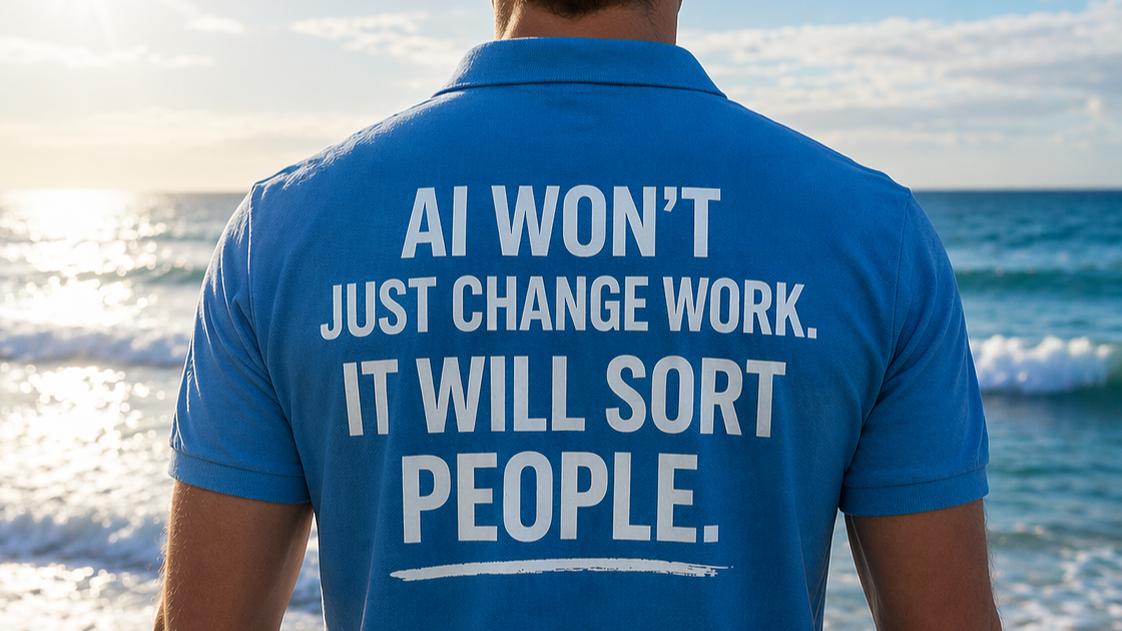
AI Won’t Just Change Work. It Will Sort People.
I am actually looking forward to a newsletter hitting my inbox on Monday.
Not because I subscribed to it.
Because I built it myself.
I built it with OpenClaw, Gemini, and an Apps Script with a weekly email trigger. It tracks the kinds of things I actually care about: rising product ideas in my niche, changes in seasonal search trends, competitor movement, and the handful of signals that genuinely deserve my attention.
That is a lot more useful to me than another generic newsletter.
Before, I depended on other people to decide what mattered, frame it, package it, and send it to me.
Now I can increasingly build systems that help me do that for myself.
And that shift feels bigger than productivity.
It feels like a change in power.
From Passive Information to Personal Intelligence Systems
I am not saying news and newsletters are irrelevant now. They are not.
But I am much less interested in passively receiving someone else’s framing when I can build tools that help me generate my own.
That is the part of AI that I think gets under-discussed.
We talk a lot about AI helping people write emails, summarize meetings, create images, or answer questions faster.
But the deeper shift is not just speed.
The deeper shift is workflow ownership.
AI allows people to build small, personalized systems around how they think, work, research, sell, create, and decide. That is not the same as using a better search box. That is a new relationship to information.
And once you start experiencing that, it is hard to go back.
The Harder Question: What Happens to Labor?
As I build more AI tools to change the way I work, I keep coming back to a harder question:
What happens to labor as these systems get better?
This week, I heard someone say that labor will have less leverage as AI improves.
I think there is truth in that.
And it is not a comfortable truth.
If more work can be automated, accelerated, or absorbed by smaller teams, then older forms of expertise and bargaining power do not hold in quite the same way.
That does not mean people become useless.
It means the terms change.
Fast.
The Adoption Gap
Then there is the second question:
What happens to the people who adopt slowly?
Right now, a lot of people still treat AI like a better email writer. A better summarizer. A better search box.
But that is not the deepest shift.
The deepest shift is using AI to generate new workflows, new systems, and new ways of thinking, building, and deciding.
Not just doing the old life faster.
Making a different life possible.
So I wonder: will everyone eventually catch up because the tools become easier, more natural, and more embedded?
Or are we watching the early formation of a divide that may last a very long time?
A divide between people who learn to collaborate with these systems at a deep level and people who stay on the surface.
I suspect the tools will lower some barriers.
I also suspect there will still be a huge gap between people who merely use AI and people who let it reorganize how they see work, knowledge, and possibility.
I do not say that lightly.
The Cost of Becoming Fluent
Getting my first AI and machine learning certifications through AWS was already a lot.
It felt like pulling myself up over the edge of a cliff into a new field because I had to.
What I have learned since then, day after day, has been immense. I have been lucky. My work has given me time, patience, repetition, room to learn, and real opportunities to keep going.
But I do not look at things the same way anymore.
As a humanities person who made this transition, I can tell you plainly: the effort it takes just to reach the point where you can follow a real conversation about RAG, Docker, AWS storage systems, structured documents, knowledge graphs, branches, repos, and commit histories is enormous.
We are not usually trained to think this way.
We are trained in interpretation, ambiguity, history, discourse, contradiction.
That training matters deeply.
But this newer world asks for another kind of literacy too.
And acquiring it can feel brutal.
This Is Not Just Technical. It Is Cultural.
That is part of why this moment feels so charged to me.
It is not just technical.
It is cultural.
It is intellectual.
It is about translation, adaptation, and the psychic cost of entering a system that was not built with your cosmovision in mind.
This may be why I keep relating the AI revolution to Homi Bhabha and hybridity.
To the experience of inhabiting an in-between space and building from it.
To conquest, imposed language, and the demand to survive inside somebody else’s structure.
To Caliban learning the master’s language and discovering that fluency is not innocence.
The master’s tools may not dismantle the master’s house.
But a lot of us are still being forced to learn them just to stay legible inside it.
Legibility Has Consequences
Every system has a language that determines who gets recognized as intelligent, credible, useful, and worth listening to.
Right now, technical fluency is increasingly part of that language.
AI. Automation. Systems thinking. Platform logic. Data structures. Repos. Workflows. Prompts. Integrations.
All of it.
You can see the limits of that world clearly.
You can critique it.
You can know it was not built with your mind in mind.
And still have to learn it.
Not because AI is automatically liberating.
Not because fluency equals justice.
Not because learning the language of power makes the system fair.
But because illegibility has consequences.
If the system cannot read you, it can sideline you.
The Real Story
That is the part I think we do not talk about enough.
For many of us, especially those coming from the humanities or other traditions of thought, this is not just skill acquisition.
It is translation under pressure.
It is learning how to render yourself intelligible in a language of power that you did not choose, but now have to navigate anyway.
And maybe that is the real story here.
Not whether AI can help us write emails faster.
Whether this new literacy will sort people the way new literacies always have.
And whether enough people will be given a real chance to acquire it before the gap hardens into something that starts to look like hierarchy.
